
Faraday
The tidiest, smartest, most striking email client ever built
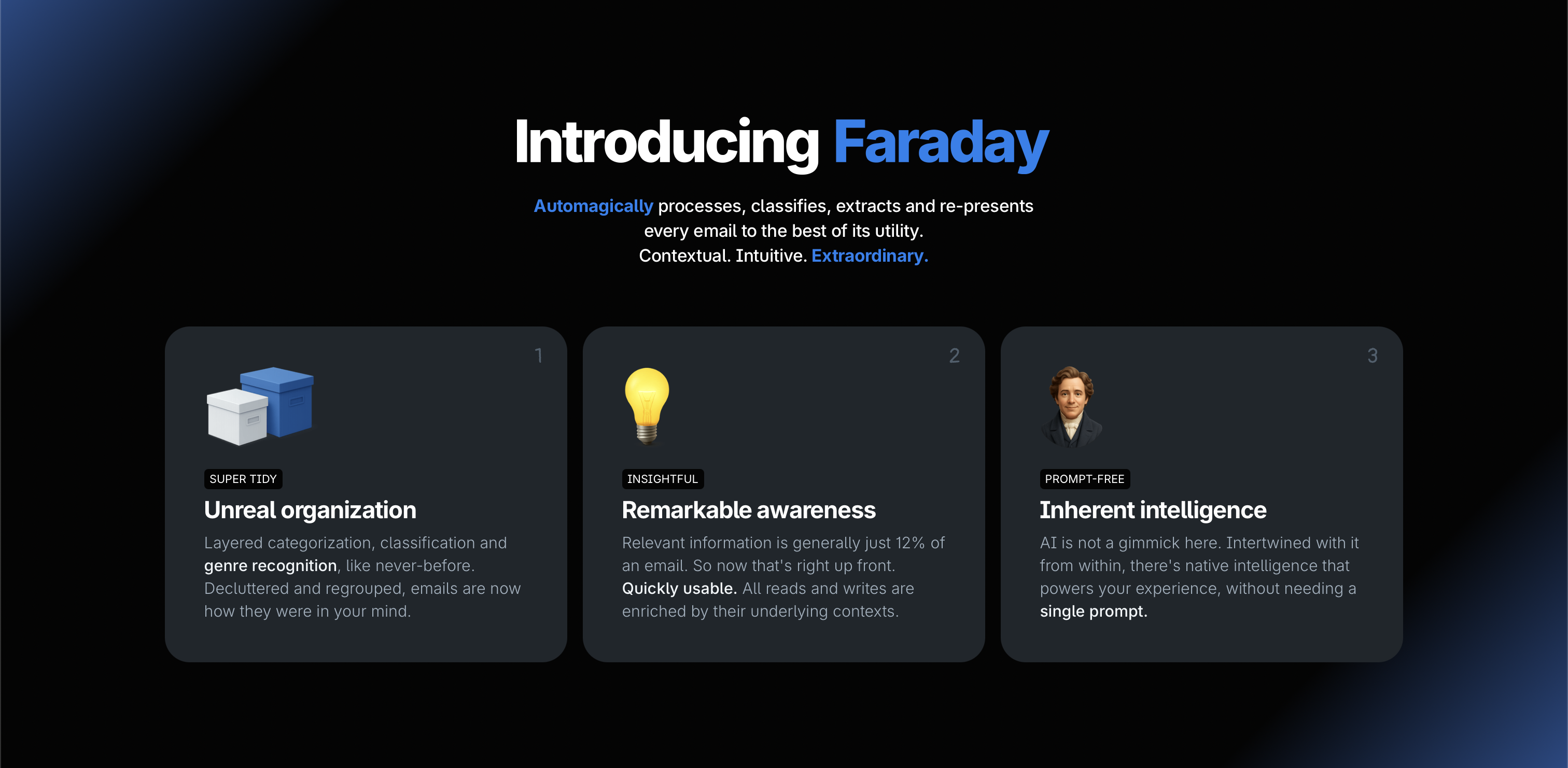
Faraday is the world's only promptlessly intelligent, highly organized, and contextually aware email client that auto-processes, classifies, extracts and re-presents each of your emails to the best of their utility, drastically reducing cognitive load, saving significant time, while staying out of your way. Securely, encryptedly, beautifully.
From its incomparable email organisation and thread resolution abilities to its dual-store architecture, Faraday was built with truly innovative, patent-pending technologies that we developed ourselves. For the first time in the world.
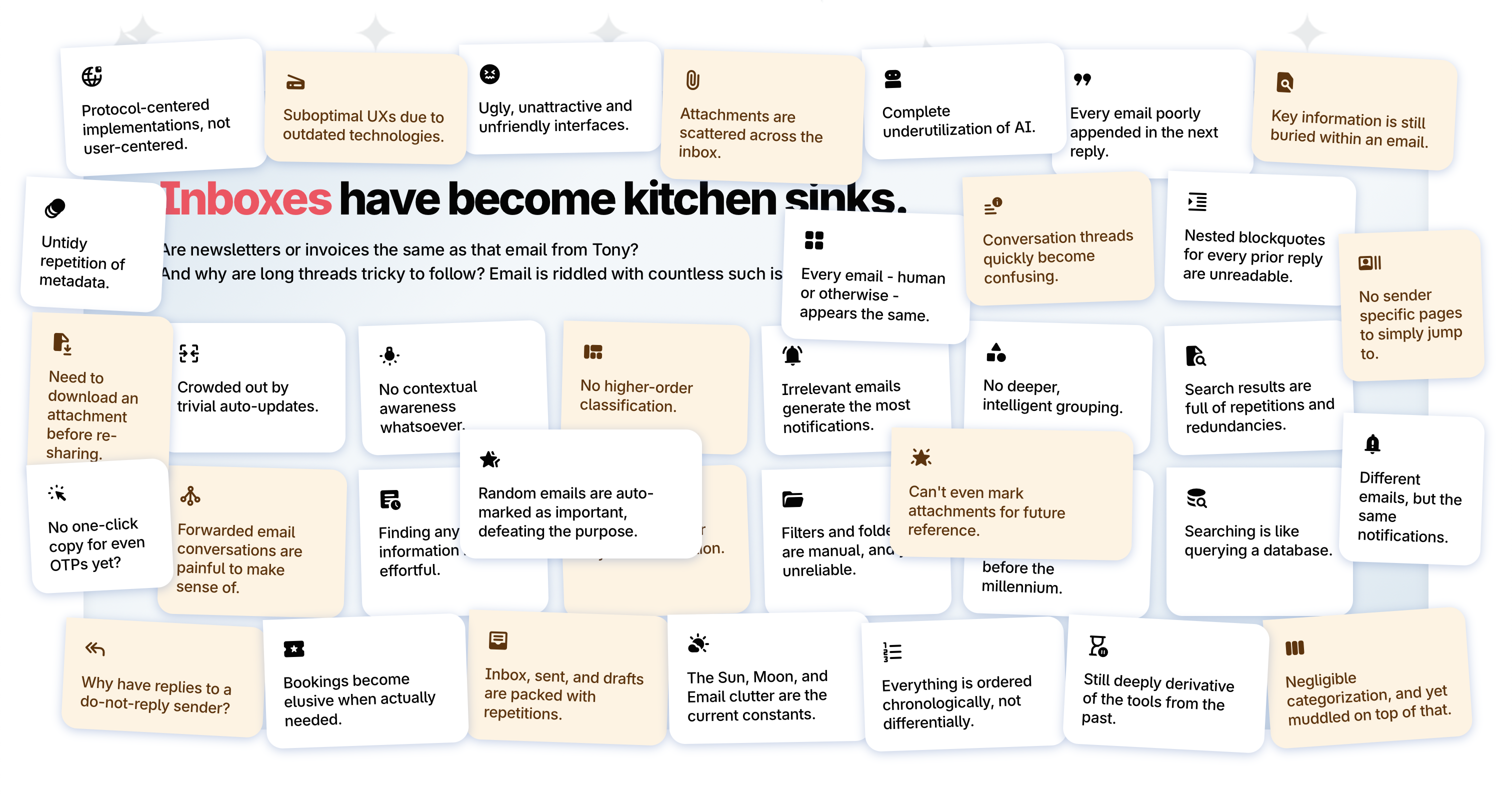
It replaces the archaic, undifferentiated table of emails in our kitchen-sink like inboxes, using a refreshing and clever orchestration of processes, delivering a remarkable experience.
Not a mere auto-drafter or a compose plugin, but an entirely superior email client.

Features
- It's an inbox that’s incomparably neat, contextually enriched, and visually striking.
- Performs a multi-tier higher order of classification, subtype differentiation, along with sender, category grouping and even genre clustering, without needing a single prompt.
- Provides a set of highly differentiated, sectional, sub-sectional, and category based views completely eliminating clutter.
- Hierarchically reconstructs each mail chain from its individual emails, resolving threads and eliminating the recursive repetition of prior emails for the first time in the world — forwarded threads will never be the same again.
- Presents a clear, segmented, conversational UX for easy comprehension, without redundancies, for all email threads.
- Insightfully identifies the key, material information in each email, usefully presenting them upfront for significant ease
- Enables multiple one-click actions across frequent. requirements, such as for copying verification codes from an email, marking emails as 'done', bulk archiving/deleting, and several more.
- Creates useful and delightful brand/sender groups to consume from or even unsubscribe quickly.
- Comprises of a rich, utilitarian handling of attachments:
- Dedicated attachments view to quickly find every attachment also with specific file-type and file-size filters
- Ability to star attachments for quick retrieval later, along with a one-click option to share them in an existing thread, without needing to download first
- Auto-changes gibberish, machine-generated attachment names to meaningful, human-readable ones
- Uses the best-in-class security and encryption standards — even resistant to quantum attacks, ensuring a highly secure and private product.
- Contextually aware and truly useful compose-assist using AI, along with a promptless provision of accurate one-click email responses.
- Generates the smartest, well-differentiated, informational notifications that give contextual details right upfront, without needing a single click, and can be sectionally turned off as well.
- Supports multi-account linkage and seamless, simultaneous access from each linked account.
- Supports an extensive list of intuitive keyboard shortcuts.
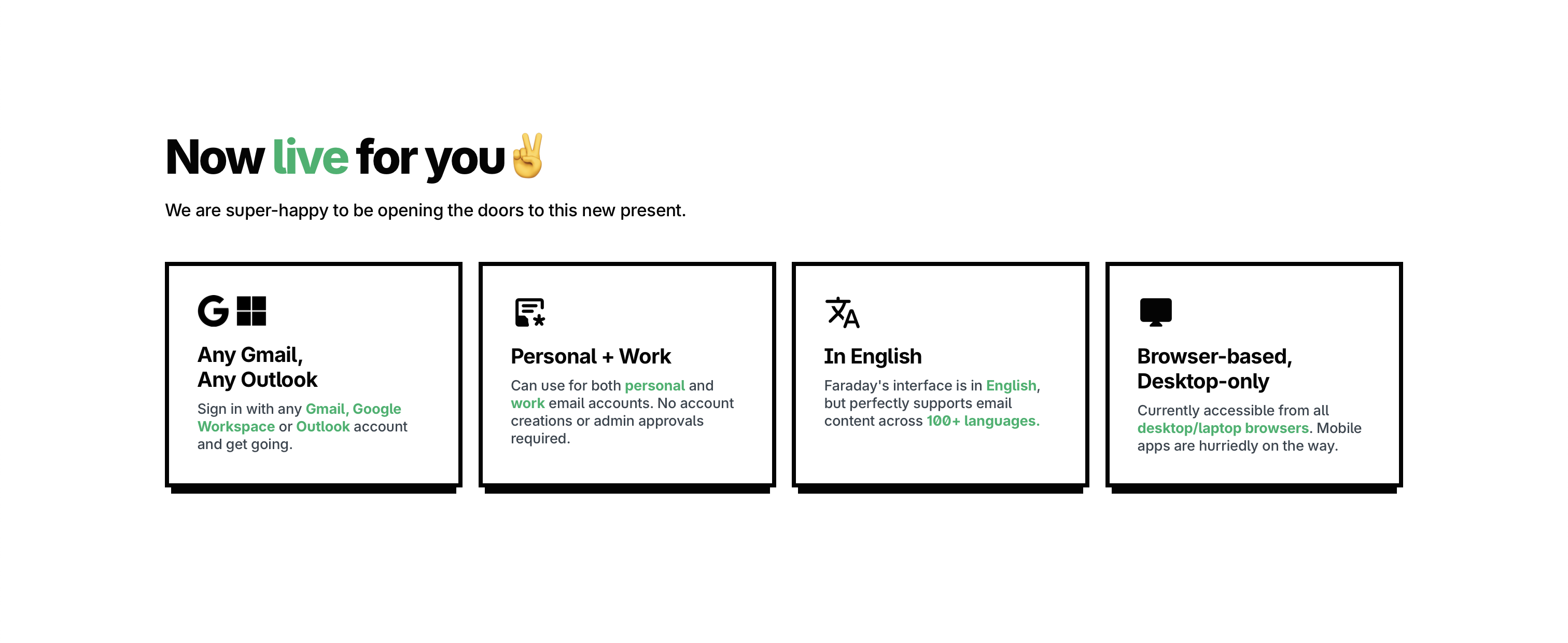
- While based in English, it supports 100+ languages for its entire set of features and operational intelligence.
Use Cases
- Accessible by all Gmail, Google Workspace and Outlook/Office 365 accounts
- Applicable for all types of email — across work and personal accounts
- Perfect for all professionals and individuals who deal with a considerable number of emails on a daily basis, including entrepreneurs, investors, consultants, marketeers, finance executives, real estate managers, salespeople, creators, artists, producers, and a few others.
Fazier Deal
Sponsors
Buy
Comments






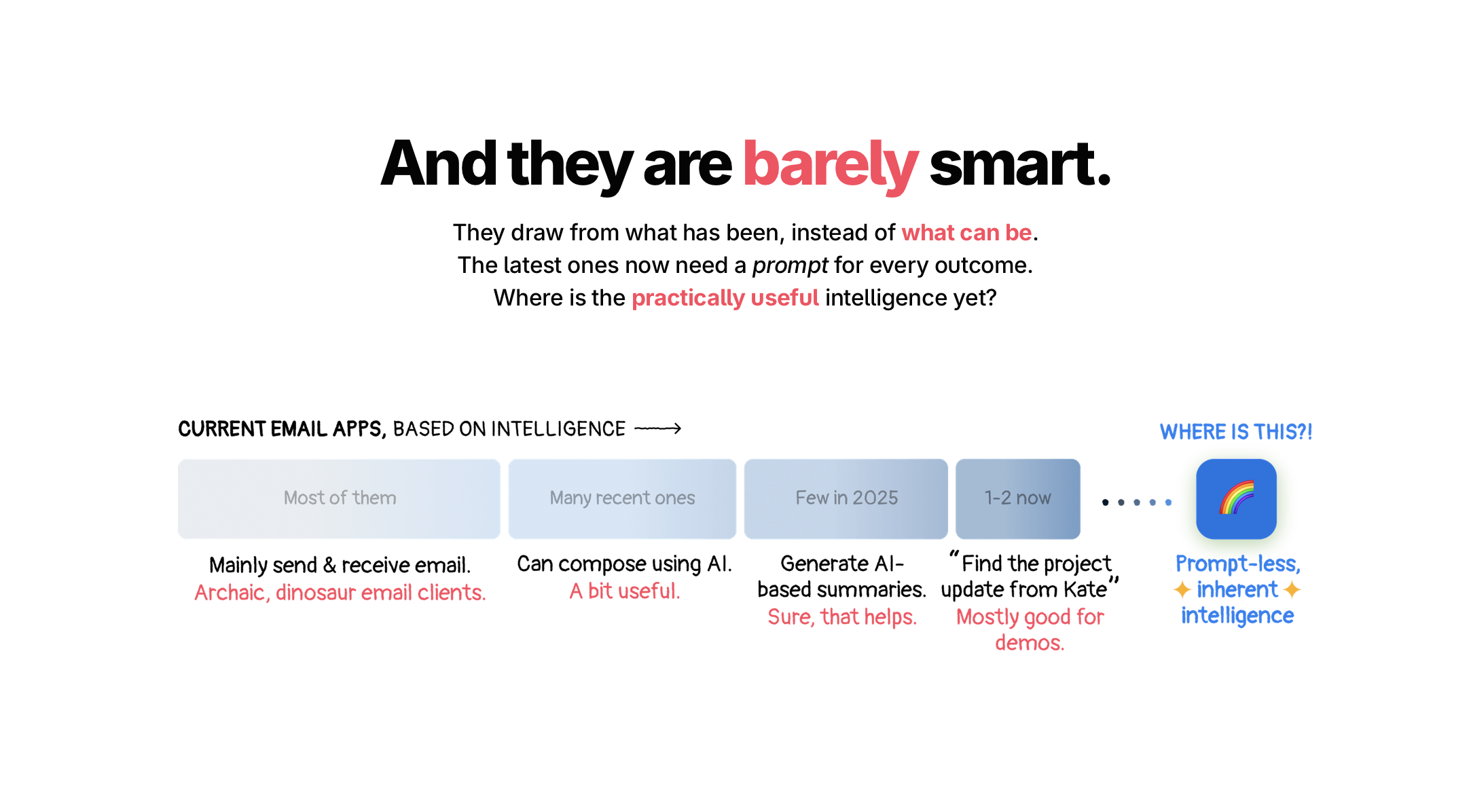
My story started with email itself. I was steered by my own annoyances with it, since my consulting days. The fact that it remains unorganized, cluttered, and fatiguing even today, became unacceptable. Even the "modern" clients today simply put our emails in a table, support a few keyboard shortcuts, a few simple features, and are done. The newer ones provide AI-based compose assist, and the newest ones now want us to prompt for each email. Chat for everything. Ugh! There is still no higher order classification, no deeper grouping. Every email — a project update, a transaction, a human message — appears the same. Key attachments are always elusive when needed. Trivial auto-updates crowd us, and long forwarded threads are still painful to follow with the untidy nature of their chaining. We therefore set out to build Faraday with 3 principles: First, user centricity is paramount, above all else. Second, there needs to be a fundamental entrenchment with AI. No mere gimmicks. And third, develop with first principles. Not borrowing from what has already been, but what can be. At each step. The result: A refreshingly original client incomparable to any other. Remarkably organised, promptlessly intelligent and visually striking✨ We essentially built Faraday with a lot of love and critical thinking🙂 So go ahead, sign in at https://faraday.email, and let us know all your thoughts and experiences!




In the world of Cookie Clicker https://cookieclicker76.io, you'll go from a humble baker to the owner of a multiverse empire, hiring grandmothers to bake and building global cookie factories.







Really interesting direction. The “promptless” approach to email organization is compelling, especially for people dealing with high daily inbox volume across multiple accounts. The thread cleanup and attachment handling features look particularly practical. One thing that could make the value clearer: add a few concrete before/after examples (raw inbox vs. Faraday view) so users can quickly understand how much cognitive load it removes in real workflows.




The attachment renaming feature is one of those small details that shows someone actually uses email heavily. I lose so much time hunting through downloads full of "IMG_4392.pdf" and "Document(3).docx" trying to find the right file. Curious about the thread resolution — does it handle cases where someone replies to an old thread with a completely new topic? That's always been the messiest part of email for me, where the subject says one thing but the conversation forked three topics ago.

This framing of reducing cognitive load rather than just “improving email productivity” really stands out. Most AI email tools focus on drafting or summarizing, but restructuring the inbox itself — especially with context-aware classification and re-presentation — feels like a deeper systems-level approach. I’m particularly curious about how “promptless intelligence” works in practice. How do you balance automation with user control, especially for edge cases where context is ambiguous? Also, do you see this replacing traditional inbox paradigms entirely, or layering on top as a smarter abstraction? Feels like you're not just building a tool, but redefining how people interact with email.
Premium Products












Fazier Deal
Sponsors
Buy



Makers
Makers
Comments
My story started with email itself. I was steered by my own annoyances with it, since my consulting days. The fact that it remains unorganized, cluttered, and fatiguing even today, became unacceptable. Even the "modern" clients today simply put our emails in a table, support a few keyboard shortcuts, a few simple features, and are done. The newer ones provide AI-based compose assist, and the newest ones now want us to prompt for each email. Chat for everything. Ugh! There is still no higher order classification, no deeper grouping. Every email — a project update, a transaction, a human message — appears the same. Key attachments are always elusive when needed. Trivial auto-updates crowd us, and long forwarded threads are still painful to follow with the untidy nature of their chaining. We therefore set out to build Faraday with 3 principles: First, user centricity is paramount, above all else. Second, there needs to be a fundamental entrenchment with AI. No mere gimmicks. And third, develop with first principles. Not borrowing from what has already been, but what can be. At each step. The result: A refreshingly original client incomparable to any other. Remarkably organised, promptlessly intelligent and visually striking✨ We essentially built Faraday with a lot of love and critical thinking🙂 So go ahead, sign in at https://faraday.email, and let us know all your thoughts and experiences!
In the world of Cookie Clicker https://cookieclicker76.io, you'll go from a humble baker to the owner of a multiverse empire, hiring grandmothers to bake and building global cookie factories.
Really interesting direction. The “promptless” approach to email organization is compelling, especially for people dealing with high daily inbox volume across multiple accounts. The thread cleanup and attachment handling features look particularly practical. One thing that could make the value clearer: add a few concrete before/after examples (raw inbox vs. Faraday view) so users can quickly understand how much cognitive load it removes in real workflows.
The attachment renaming feature is one of those small details that shows someone actually uses email heavily. I lose so much time hunting through downloads full of "IMG_4392.pdf" and "Document(3).docx" trying to find the right file. Curious about the thread resolution — does it handle cases where someone replies to an old thread with a completely new topic? That's always been the messiest part of email for me, where the subject says one thing but the conversation forked three topics ago.
This framing of reducing cognitive load rather than just “improving email productivity” really stands out. Most AI email tools focus on drafting or summarizing, but restructuring the inbox itself — especially with context-aware classification and re-presentation — feels like a deeper systems-level approach. I’m particularly curious about how “promptless intelligence” works in practice. How do you balance automation with user control, especially for edge cases where context is ambiguous? Also, do you see this replacing traditional inbox paradigms entirely, or layering on top as a smarter abstraction? Feels like you're not just building a tool, but redefining how people interact with email.
Premium Products
New to Fazier?

Find your next favorite product or submit your own. Made by @FalakDigital.
Copyright ©2025. All Rights Reserved